
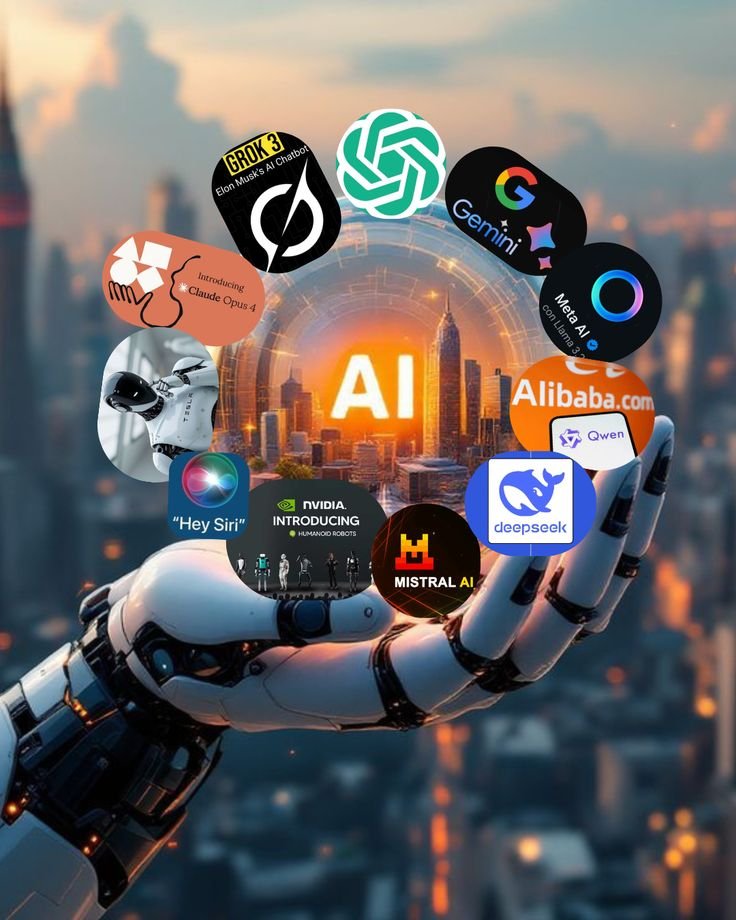
Artificial intelligence (AI) is changing digital marketing from a largely manual, campaign-based activity into a more data-driven, personalized, automated, and predictive process. Marketers can now use AI to understand customers, create content, optimize advertising, predict behavior, and interact with audiences in real time.
Recent industry research shows that AI has moved beyond experimentation: marketers are increasingly using both generative AI for content creation and predictive AI for analysis and decision-making. SSalesforce+1
1. Personalized Customer Experiences
AI can analyze customer behavior—such as searches, purchases, website activity, and engagement—to determine what different customers are likely to want.
For example, an e-commerce website can use AI to recommend products based on a customer’s previous purchases and browsing behavior.
This enables businesses to move from:
“One message for everyone” → “The right message for each customer.”
Personalization and campaign optimization are among the areas marketers identify as having particularly significant AI impact. NNielsen
2. AI-Powered Content Creation
Generative AI can help marketers produce:
- Blog posts and articles
- Social media captions
- Email campaigns
- Advertisement copy
- Product descriptions
- Video and image concepts
- SEO content
- Marketing ideas and campaign variations
This doesn’t necessarily eliminate the need for human marketers. Instead, AI can handle much of the first-draft and repetitive work, allowing marketers to spend more time on strategy, creativity, brand voice, and quality control.
A 2025 Nielsen study found that 47% of companies surveyed were using AI for content creation. NNielsen
3. Smarter Advertising
AI is transforming digital advertising by helping marketers decide:
- Who should see an advertisement
- Which creative version to show
- When an ad should be displayed
- Which platforms deserve more budget
- Which audiences are most likely to convert
AI can continuously analyze campaign performance and identify patterns that would be difficult to detect manually.
This makes advertising increasingly dynamic rather than static.
4. Predictive Analytics
Traditional marketing often asks:
“What happened?”
AI allows marketers to increasingly ask:
“What is likely to happen next?”
Predictive AI can forecast things such as:
- Which customers may make a purchase
- Which customers may stop engaging
- Which products may become popular
- Which leads are most valuable
- Which campaigns are likely to perform well
Nielsen reports that 46% of companies surveyed use predictive analytics in marketing-related activities. NNielsen
5. Chatbots and Conversational Marketing
AI-powered chatbots can communicate with customers 24/7 through websites, messaging platforms, and other digital channels.
They can help with:
- Answering frequently asked questions
- Recommending products
- Providing basic customer support
- Collecting leads
- Guiding customers through purchases
- Handling routine inquiries
The trend is also moving toward more conversational customer experiences. Salesforce reported in 2026 that 83% of marketers surveyed said customers increasingly expect two-way conversations with brands. SSalesforce
6. Better Customer Segmentation
Previously, marketers might divide customers into broad groups such as:
- Age
- Gender
- Location
- Income
AI can combine many more signals, including behavior, purchase history, interests, engagement, and browsing patterns.
This allows marketers to create more precise audience segments and develop campaigns for specific customer groups.
Nielsen reported that 44% of companies surveyed were using AI for customer segmentation. NNielsen
7. Search Engine Optimization Is Changing
AI is also changing SEO.
People increasingly use AI-powered search and answer engines to find information. As a result, marketers need to think beyond traditional keyword rankings and consider whether their content is useful, authoritative, structured, and likely to be referenced in AI-generated answers.
Salesforce’s 2026 research found that 85% of marketers surveyed said AI is reshaping their SEO strategy, while 88% reported beginning to optimize for AI-generated responses. SSalesforce
8. Automated Marketing Workflows
AI can automate repetitive marketing activities such as:
Customer visits website → AI identifies interest → customer receives personalized email → AI recommends product → customer makes purchase → AI triggers follow-up campaign
This type of automation allows marketers to manage large numbers of customer journeys simultaneously.
9. Improved Marketing Analytics
Digital marketing generates enormous amounts of data. AI can process this information much faster than humans and identify relationships between:
Campaign → Audience → Engagement → Conversion → Revenue
This helps marketers understand not only how many people clicked an advertisement, but also which audiences, messages, channels, and customer journeys are contributing to business outcomes.
10. Challenges of AI in Digital Marketing
AI also introduces important challenges.
Data privacy
AI depends heavily on customer data, making privacy, consent, and responsible data management increasingly important.
Accuracy
AI-generated content can contain incorrect information or inappropriate recommendations, so human review remains important.
Brand authenticity
If companies rely too heavily on automated content, marketing can become repetitive or lose its distinctive human voice.
Skills
Marketers increasingly need to understand AI tools, data, analytics, prompting, automation, and responsible AI use.
Data quality
AI is only as useful as the information it receives. Salesforce’s 2026 research in India found that 81% of marketers surveyed had adopted AI, while fragmented or irrelevant customer data remained a major obstacle to using it effectively. SSalesforce
The Future of Digital Marketing
The major change is not simply that AI is replacing marketers. Rather, AI is changing what marketers spend their time doing.
| Traditional digital marketing | AI-powered digital marketing |
|---|---|
| Manual analysis | Automated analysis |
| Broad targeting | Personalized targeting |
| Manual content creation | AI-assisted content creation |
| Reactive decisions | Predictive decisions |
| Fixed campaigns | Dynamic campaigns |
| Scheduled customer communication | Real-time communication |
| Manual reporting | Automated insights |
In short, AI is making digital marketing more personalized, predictive, automated, and data-driven. The marketers who benefit most are likely to be those who combine AI’s ability to process data and automate tasks with human creativity, strategic thinking, judgment, and understanding of customers.
For India specifically, the shift is already substantial: Ipsos reported that digital advertising accounted for 44% of India’s advertising market in FY2025, while AI is creating new opportunities for personalization at scale.